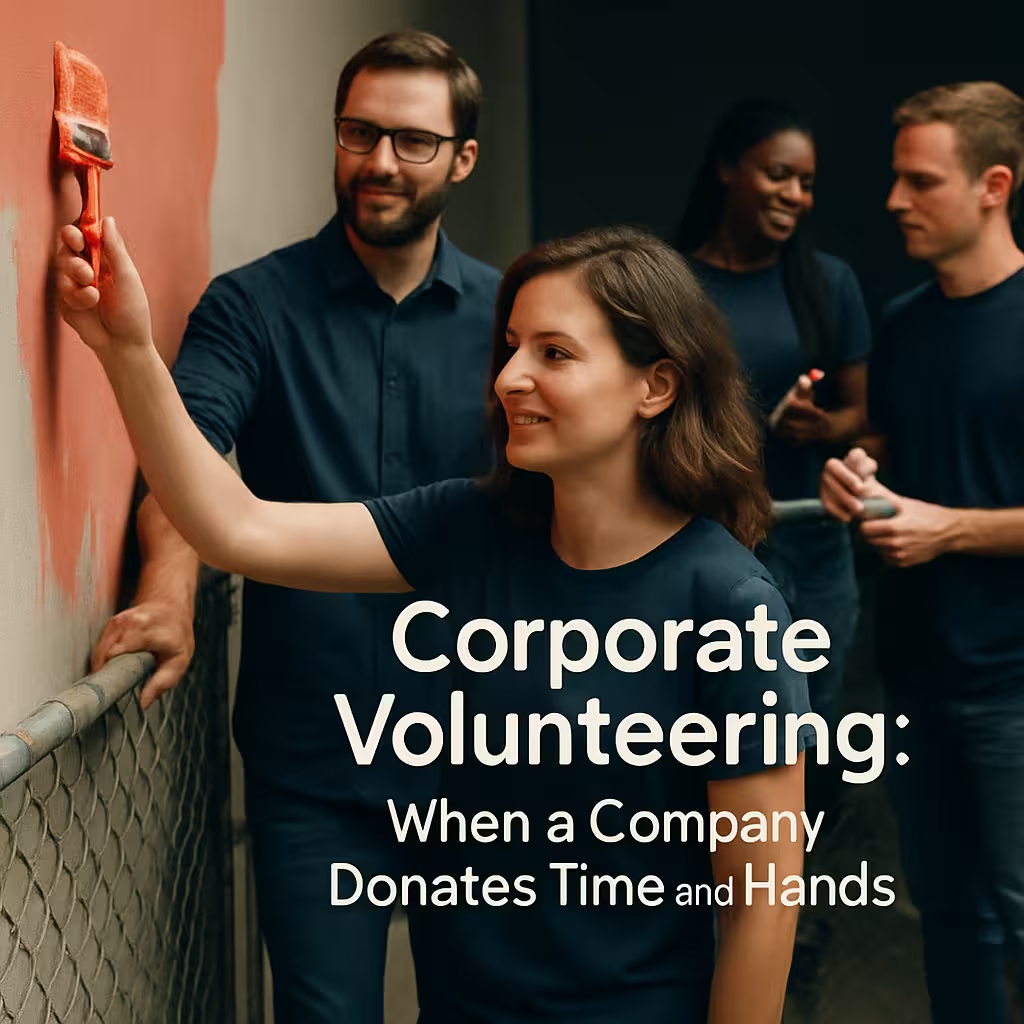
“We don’t have funds right now, but we have people. We’ll send five employees for a day to help with painting, cleaning or fixing the fence.” Sounds like a poor relation of sponsorship? Think again. Corporate volunteering is a growing form of non-monetary support—and for many nonprofits it can be more valuable than a bank transfer. Here’s an overview of how it works, its benefits (and pitfalls), and how to turn it into a mutually beneficial partnership.
What is corporate volunteering? (and why it’s not just “donating labour”)
Corporate volunteering is an organized form of support where a company releases its employees for a limited period (e.g., one day, a weekend, a week) to volunteer for a nonprofit. It can involve manual tasks (painting, cleaning, building), but also professional assistance (accounting, IT, website development, mentoring).
Unlike traditional sponsorship, money doesn’t change hands here—what is donated is people’s time and expertise. For the company this is an in-kind gift that can be valued (for example, by the cost of employees’ time), but tax recognition is more complicated (see below).
Why should a company do volunteering? (benefits for the sponsor)
| Benefit | Explanation |
|---|---|
| Team building | Working together outside the office strengthens team bonds. |
| Company culture | Employees feel proud to work for a company that gives back. |
| PR and publicity | Good deeds can be communicated (press releases, social media). |
| New skills | Employees try different kinds of work and develop empathy. |
| Tax advantage | Can it be claimed as a donation? Only to a limited degree—the value of labour is generally not deductible, but materials (paint, tools) are. |
Why should a nonprofit want corporate volunteers?
- Save money – you don’t have to hire an external contractor for painting, cleaning or repairs.
- Gain experts – accountants, lawyers, IT specialists can help pro bono.
- Build relationships – a volunteer day today can turn into financial sponsorship tomorrow.
- Media reach – companies often like to talk about their involvement, which raises your visibility.
How to do it in practice (step by step)
1. Contacting the company
Don’t write “we need money,” but “come see how your people can help.” Show concrete activities: painting a fence, clearing a garden, an accounting close, fixing computers.
2. Project preparation
- How many people do you need? (5, 10, 20)
- For how long? (half day, full day)
- What work will they do? (it must be safe, meaningful and manageable)
- Who will lead them? (your coordinator)
3. Agreement
Even non-monetary sponsorship should have a written agreement. Specify: number of people, hours, description of activities, an estimated value (e.g., 8 hours × 10 people × 500 CZK/hour = 40,000 CZK) – for the company’s internal records, but not tax-deductible. Also clarify who bears liability for injuries (employees are insured by their employer, but address this contractually).
4. Implementation
Provide materials (paint, brushes, cloths) or ask the company to bring them. Divide tasks and have a backup plan.
5. Thanks and publicity
Take photos, publish a post on your website, send the company a certificate. Invite them to another event.
Good to know (and what to watch out for)
Tax aspect – important!
The value of volunteer labour is not a tax-deductible expense for the company (you cannot deduct “lost time”). If the company donates materials (paint, tools, computers), those can be deducted as a donation or advertised expense (if branded). Recommendation: split the volunteer day into two parts – the company buys materials (a donation or sponsorship) and employees provide the labour for free (an in-kind, non-tax-deductible contribution).
Legal responsibility
Employees are insured by their employer for workplace injuries. If they work at your site, they should remain on company time and under their employer’s supervision (or yours, but then responsibility may shift). Address this in the contract.
Rewarding the company
What can you offer in return? A logo on your website, a mention in the annual report, a plaque, an invitation to an event. As with sponsorship, provide a reciprocal benefit.
A practical example – Garden for a Children’s Home
A children’s home needed its garden renovated – overgrown grounds, an old swing, no seating. They approached a local construction company. The company didn’t have cash to give, but sent 8 employees for two days (including a foreman and tools). The children’s home bought wood and paint from a grant. The result: a new playground, a terrace, cleaned grounds. The company received an article in the regional press and an invitation to the opening. A year later the company added a financial donation – the relationship had grown.
“When a company sent us five accountants for a week, they saved our audit. We wouldn’t have had the money anyway, but their time was priceless.”
– director of a small nonprofit
Summary – three points to remember
- Corporate volunteering is not a replacement for money, but a great complement – especially for manual work, cleaning, repairs and professional pro bono help.
- Contractually secure responsibility and materials – the value of labour isn’t tax-deductible, but materials can be.
- Make the company a hero – photos, thanks, publicity. Even without money you can build a strong partnership.
Author: Sponza Editorial Team
Photographs: (illustrative – group of people in team shirts with paint and tools)
Štítky: Partnerství, Podpora, Dobrovolnictví