
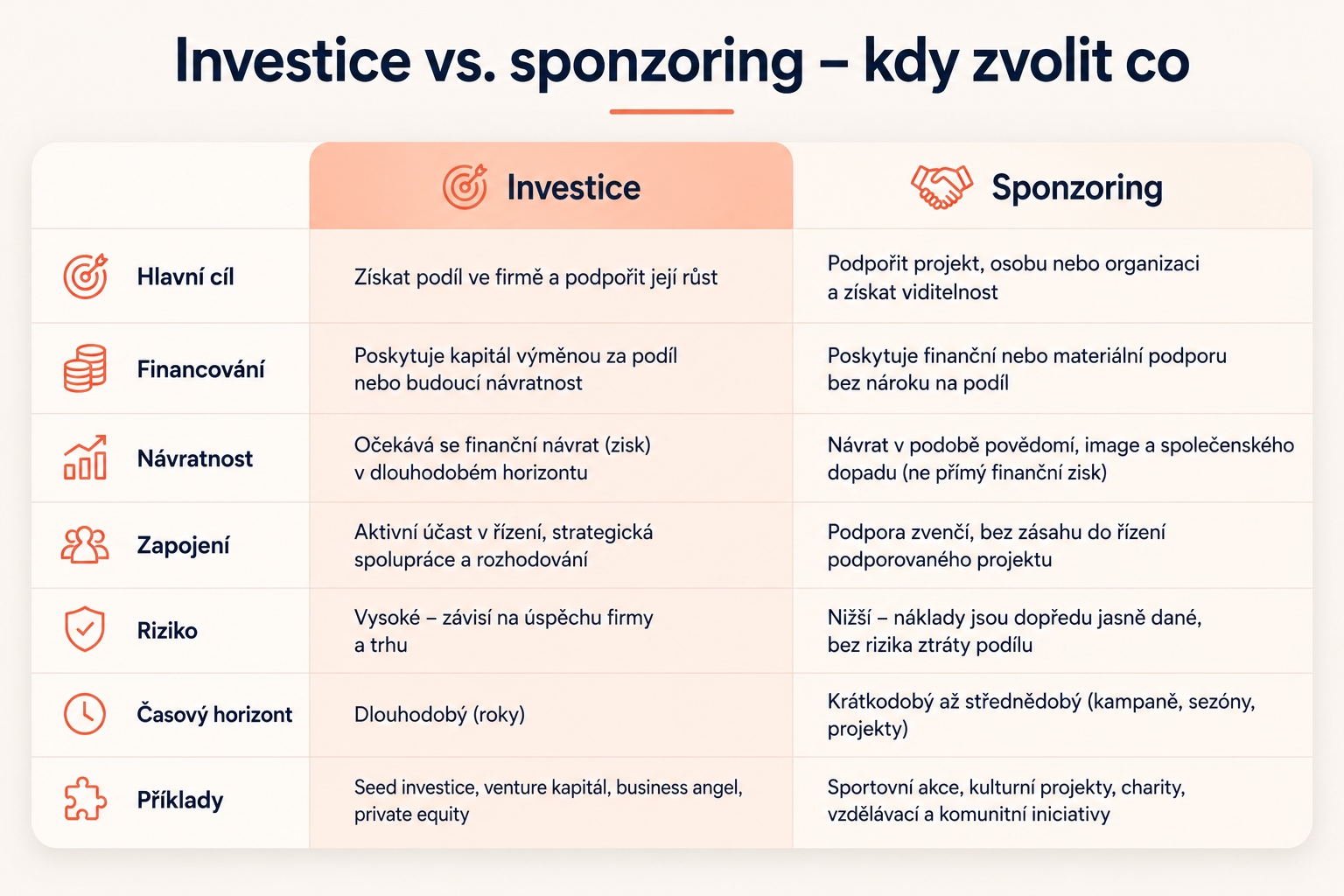
You need money to grow. Who is the right partner? An investor who injects capital and takes a stake? Or a sponsor who supports your project without claiming ownership? Each route has different rules, a different degree of control and a different goal. The table below outlines the key differences between investment and sponsorship.
Comparing investment and sponsorship
| Investment | Sponsorship |
|---|---|
| Investor acquires a stake (shares, equity) | Sponsor does not take a stake, only contractual deliverables |
| Investor joins management, may have veto rights | Sponsor does not participate in management |
| Goal: profit from sale of the stake (exit) | Goal: visibility, brand image, community support |
| Funds for growth, scaling, hiring | Support for a specific project, season, or event |
| Return on investment (ROI) and an exit are expected | Fulfilment of the agreement is expected, not an exit |
| Suitable for companies, startups, expansion | Suitable for athletes, artists, researchers, local projects |
| Investment is usually larger (millions) | Support is typically smaller, but can be long-term |
| Investor bears the risk of loss | Sponsor minimizes risk through a contract |
What follows from the table?
Investment suits those who want to grow quickly, build a company and don’t mind sharing decision-making. An investor backs your business plan and expects their capital to return with a profit. A sponsor, by contrast, is ideal for concrete projects — a sports season, a piece of art, or a research trip. They provide support but leave you in charge of your work.
Which is more advantageous for you?
- Investment – if you are founding a company, want to scale, hire people and enter new markets. You are willing to let someone into decision-making.
- Sponsorship – if you are an athlete, artist, researcher or local activist. You don’t want to lose control and need support for a specific goal.
Can they be combined?
Yes. Many successful projects begin with sponsorship — it provides the first funds and early results. Later, investors arrive because there is something to show. A locally supported athlete may reach higher levels and attract bigger brands. A researcher with a grant for a prototype can win an initial customer and then bring in venture capital. Don’t be afraid to combine approaches; different growth stages call for different partners.
First a sponsor helped me — they bought my equipment. Then, when I had results, an investor came. Without that initial support I wouldn’t have had anything to show. The two do not exclude each other; on the contrary, they complement each other beautifully.
Adam, founder of a technology company and former athlete
How to decide?
Ask yourself: Do I want to build a business that gives equity to investors, or do I want to focus on my craft, art or sport? For the first, an investor can help; for the second, a sponsor is the better fit. Both paths are valid — they simply lead to different destinations. And remember: you can start with a sponsor and bring investors on board later.
Author: Sponza Editorial Team
Photography: (illustrative – deciding between investment and sponsorship)